
Reciprocity on the Range: Removing Barriers for Sagebrush Birds
By Jay Cooney
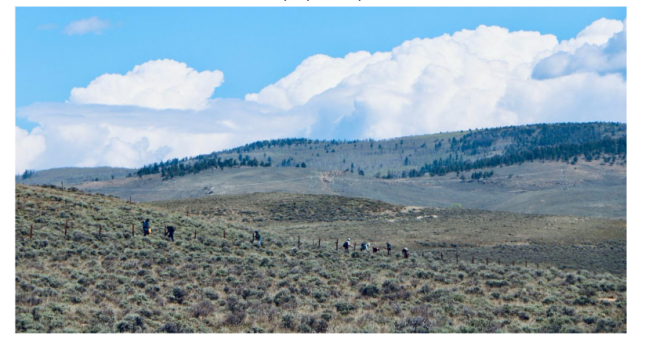
A volunteer crew removing unused fencing from public land in the sagebrush. Photo by the author.
Beneath the volcanic dome of San Antonio Mountain, rising gently above the sweeping Taos Plateau, the chattering of Sage Thrashers and buzzing of Brewer’s Sparrows fills the air as much as the sweet scent of sage. My introduction to this enchanting landscape came through a 2024 volunteer opportunity with the New Mexico chapter of Backcountry Hunters & Anglers (BHA), a grassroots organization dedicated to wild public lands, waters, and wildlife. A crew gathered on the sagebrush steppe to remove 2 miles of unused fencing, work mostly intended to aid pronghorn, the Pleistocene survivors evolved to race across unobstructed ranges at the highest speed of any American mammal. Fence removal projects also benefit the numerous bird species associated with sagebrush and offer immersion into an ecosystem that defines the American West.
A vast ‘Sagebrush Sea’ covers 170 million acres of the Intermountain West, forming one of the most intact and least human-altered biomes on Earth. Nearly 100 bird species are closely associated with sage, from cryptic, insect-eating Sagebrush Sparrows to striking Ferruginous Hawks that nab jackrabbits. Five birds in particular, including Sage Thrashers and Brewer’s Sparrows, are sagebrush obligates whose very existence depends on contiguous, healthy tracts of this habitat. Despite its magnitude, the Sagebrush Sea was severely diminished by historic overgrazing and conversion to palatable nonnative grasses, and roughly 1.3 million acres continue to be lost annually. Fencing is a pervasive form of habitat fragmentation on the treeless steppe, creating barriers that can entangle low-flying raptors and migrating elk alike.
Removing unused fencing from the Taos Plateau instilled a feeling of hands-on reciprocity that stuck with me. This May, I caught up with the BHA Habitat Stewardship Coordinator who led the 2024 volunteer crew, a Santa Fe resident (and singer-songwriter) named Bard Edrington V. As we carpooled towards another fence removal site on sage-blanketed BLM land in Colorado’s verdant Gunnison Basin, Bard’s passion for wildlife was evident in the pronghorn shed resting on his dashboard. We chatted about the myriad threats facing public lands, from privatization to federal funding cuts, and Bard observed that BHA fence removal projects make such policy issues feel more palpable for volunteers newly invested in these threatened places. In his experience, these stewardship opportunities provide, “a unique chance to give back and leave a place better than you found it.” The essence of ecological reciprocity.
The Colorado site was located at the heart of the range of Gunnison Sage-Grouse, an umbrella species for the health of sagebrush ecosystems that directly benefits from fence removals. As low-flyers, sage-grouse succumb to collisions with fence lines, and fence posts create artificial perches for nest predators like ravens. With each wire strand cut and T-post uprooted, our crew of fifteen volunteers improved the ability of sage-grouse to move freely across the steppe. As we traipsed through the sagebrush carrying rolls of barbed wire, I reflected on how ecological reciprocity is more than an abstract ideal. Reciprocity is an active exertion of our restorative potential, expressed in sweat through demanding work that mends rather than fragments landscapes. The beauty of conservation is its ability to amplify our species’ best attributes: to inspire prior strangers to coalesce around shared devotion to the captivating birds and public lands that enrich our lives with more gifts than we could ever hope to repay.
If this article inspired you to get involved, BHA is hosting upcoming stewardship opportunities on the Taos Plateau on June 26 and July 25.
Jay Cooney is a conservation writer contributing articles for Wild Birds Unlimited of Santa Fe and Albuquerque East. You can also find his writings at jaymcooney.substack.com